

Strategic architecture · Stage 02 sample output
Vela
Project management built for construction
This is an illustrative example. The company scenario and figures show how the work is presented; they are not reported client results or promised outcomes.
- Company
- Vela SaaS
- Sector
- Construction tech
- Timeline
- 14–21 days
- Strategist
- Apostolos Bolkas
Executive memorandum
Client context & commercial brief
Vela is a B2B SaaS platform built specifically for construction project management. Unlike generic tools, it handles construction-native workflows: job costing, subcontractor tiers, union rates, and site-level resource allocation.
When this engagement began, Vela had a working product, a handful of strong customers, and a pipeline that felt unpredictable. The brief: figure out who to go after, what to say to them, and what to do first.
Blueprint index
7 sections
Engagement specs
14–21 days from kickoff • Fixed flat fee (€3,500)
01 · Ideal customer profile
Target account definition
Who we are going after
Operations Directors and Project Executives at regional construction firms with 75–400 employees, running five or more simultaneous projects. They own the P&L at the project level and answer to ownership when margins slip.
- Trigger event
- A project that came in 15–25% over budget with no early warning. The pain is still fresh.
- Buying signal
- Actively evaluating software alternatives, or frustrated enough with spreadsheets to start looking.
- Disqualifier
- Mega-project general contractors with dedicated IT departments because they need Procore, not Vela.
02 · Core problem
Market friction analysis
The real issue
The surface symptom
Construction teams are managing complex, multi-site resource allocation with tools built for software teams. The result: by the time a cost overrun surfaces in the weekly report, it is already locked in.
The structural reality
The problem is not bad project management. It is that the data arrives too late to act on. Every construction firm using spreadsheets or generic task tools made that choice in the past, and now they are living with the consequences.
03 · Positioning statement
Defensible market stance
The claim we can defend
“For construction operations teams running five or more simultaneous projects, Vela is the only project management platform that gives real-time resource and cost visibility at the job-site level, without the six-month configuration overhead required by generic tools.”
Why this works
It names the buyer precisely, states the outcome they want, and makes the trade-off with alternatives explicit without attacking competitors by name.
Stress test
Can competitors say this? No. Generic tools cannot claim construction-native workflows, and enterprise platforms cannot claim simplicity. This position is defensible.
04 · Differentiator
Moat & architecture
What they cannot copy
Vela is built on construction-specific data models including job codes, subcontractor tiers, union wage rules, and equipment allocation that competitors either do not support or take months of custom setup to approximate.
This is not a feature advantage, it is structural. The moment a construction firm opens Vela, it speaks their language. Enterprise platforms are built for massive contractors, and generic tools are built for software teams. Vela is built for the regional contractors in between, and that market gap is widening.
05 · Core messaging pillar
Communication foundation
The message that runs through everything
The claim
“Your projects are not running over budget because of bad decisions. They are running over because your tools cannot show you what is happening until it is too late.”
Buyer fear it addresses
Looking unprepared in front of executive leadership when a project exceeds budget, not because of poor management, but because the cost blind spots were invisible until it was too late.
Proof angle
A regional contractor reduced project cost overruns by 34% in two quarters, not by hiring new staff, but by catching resource conflicts three weeks earlier.
06 · First 30 days
Immediate fix sequence
What happens next
-
01
Day 01–10
Audit closed-won deals from the last 12 months.
Identify the key signals in company size, project volume, and software setup that predict which prospects close versus which ones drain sales time. Stop selling to the second group.
-
02
Day 11–20
Rewrite the homepage around the outcome, not the category.
The current headline says 'project management for construction.' It needs to say 'know your project costs before they are locked in.' One rewrite, tested against current traffic within two weeks.
-
03
Day 21–30
Turn the 34% overrun reduction into the sales team’s primary asset.
One-page summary, one social post, and one outbound email template. Used in every sales conversation until it stops working. Right now this result is mentioned in passing, but it should be your opening proof point.
07 · The strategic diagnosis
Core recommendation
The one thing holding this back
The current positioning buries the real differentiator. 'Built for construction' describes the product, but it fails to explain the cost of staying with the wrong tools. Every construction firm relying on spreadsheets already made that choice in the past. Your messaging should show the financial cost of inaction, not just argue that your software is purpose-built.
Methodology
What your Blueprint includes.
Your engagement uses your market research, interviews, and business context to produce:
-
Market snapshot
Category analysis, competitor positioning, and buyer signal research before a single client conversation.
-
Team conversations
Conversations with sales and customer success to uncover what your buyers ask on real calls.
-
ICP definition
Built from CRM data and interview patterns, not assumptions. Includes disqualifiers.
-
Competitive positioning
Where you win, where you lose, and what claim you can actually defend with proof.
-
Messaging pillars
Core value propositions paired with buyer psychology, customer proof points, and sample copy ready for campaigns.
-
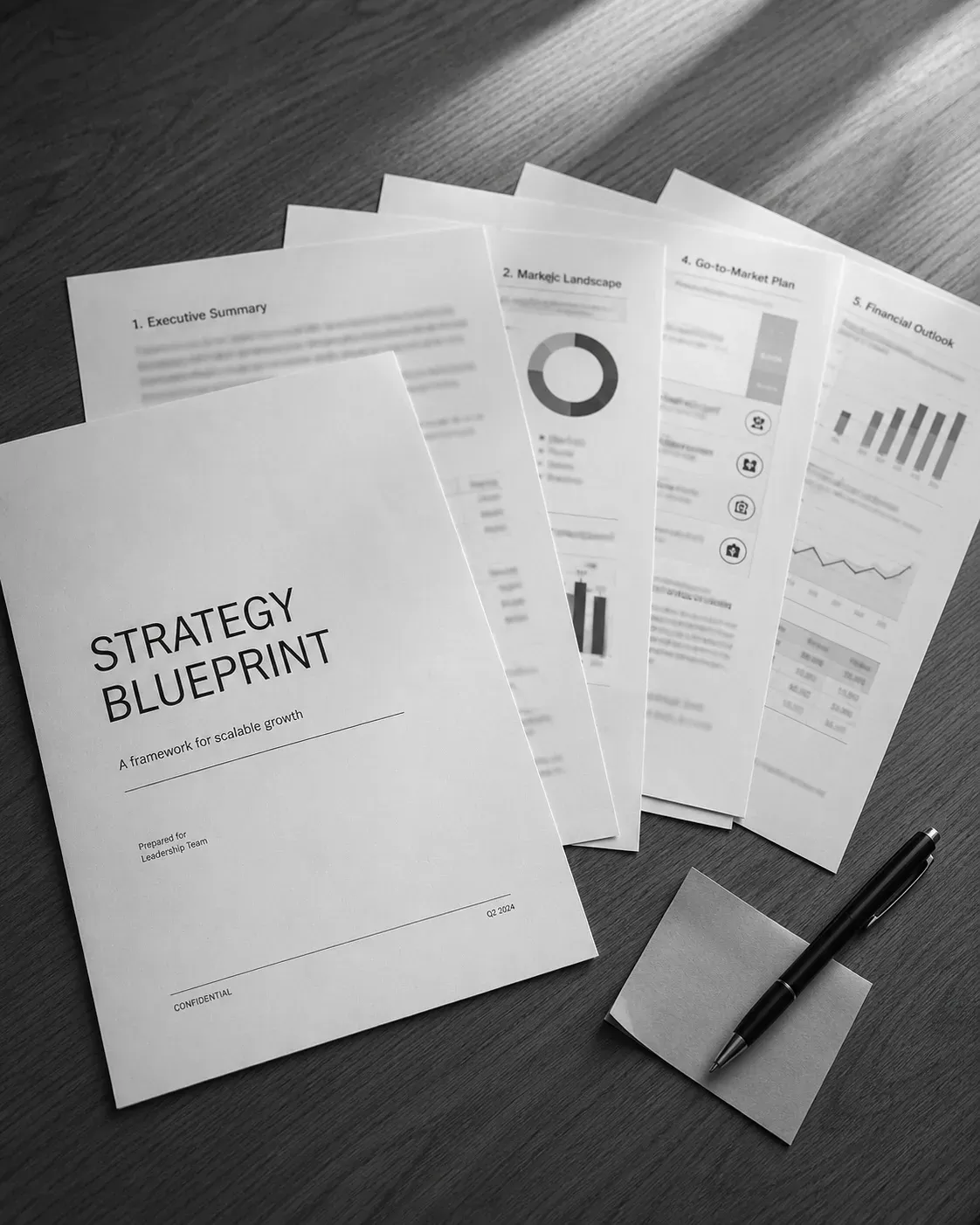
12-month roadmap
Priorities for the year, starting with a focused 90-day plan (its first 30 days are shown above), with explicit exclusions to keep the team focused.