What happens when B2B buyers search
B2B buyers now get answers from AI. GEO ensures your company's knowledge is found, understood, and reused in AI-generated answers.

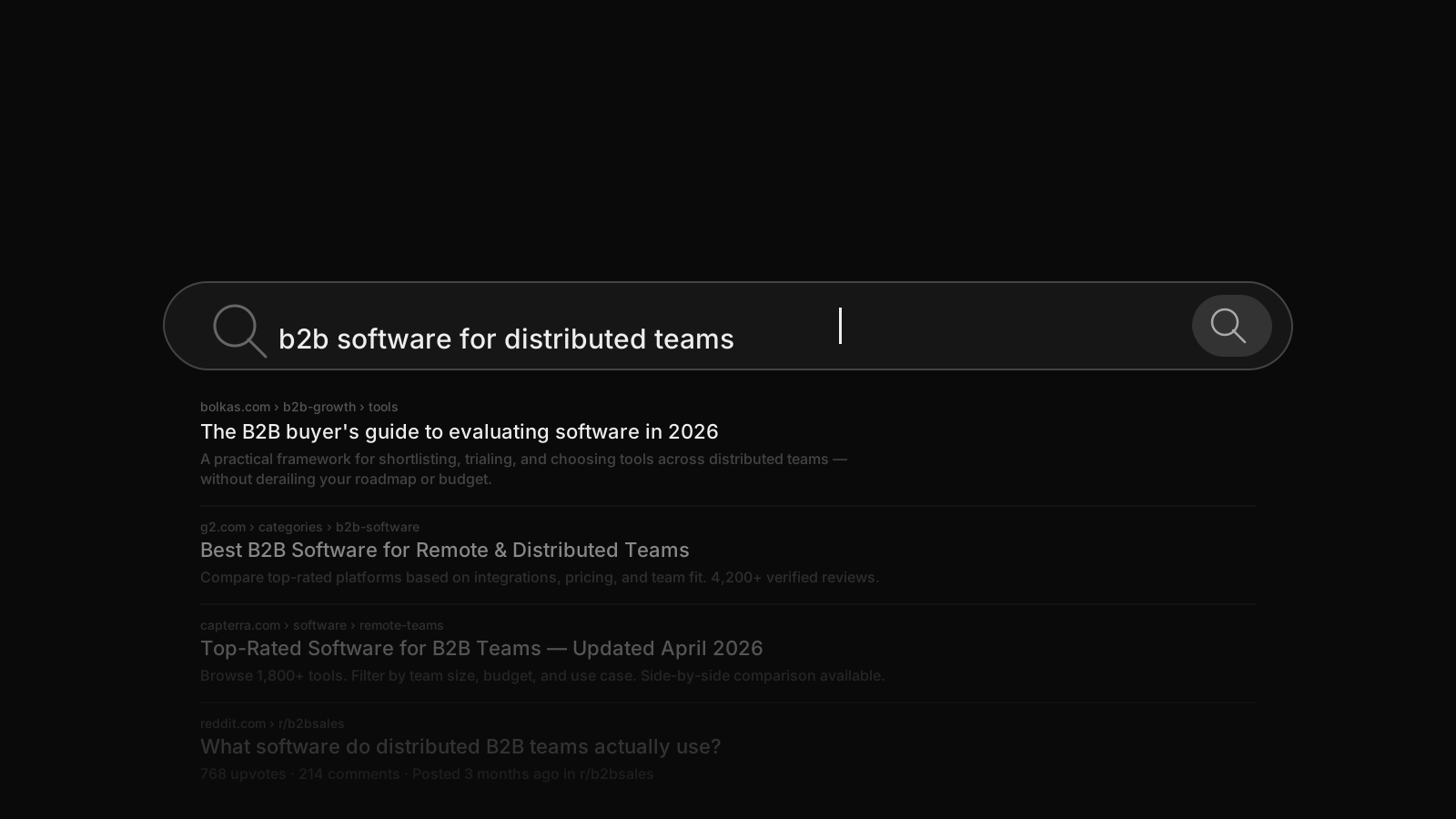
The way B2B buyers look for answers has quietly changed.
Instead of opening ten tabs and comparing sources, they ask a question and get a single response. That response summarises the landscape, frames the problem, and often suggests a direction. By the time a buyer reaches a website, an opinion has already formed.
This matters because those answers don’t come from nowhere. They’re built from sources that generative systems can access, understand, and trust. If your company isn’t part of that pool, it’s not just hard to find.
It’s missing from the conversation entirely.
Generative engine optimisation, or GEO, is the work of making sure your company’s knowledge can be found, understood, and reused inside AI-generated answers. Not louder. Not more persuasive. Just clear enough to be reused correctly.
How systems decide
Generative systems work with two kinds of information simultaneously.
One part comes from long-term training. Over time, models absorb patterns from public sources like Wikipedia, academic research, industry publications, and well-structured corporate content. Brands that appear consistently in these environments become associated with specific topics and problems.
The other part comes from real-time retrieval. When a question is asked, the system pulls live documents, processes what it can within a limited window, and constructs an answer from that material.
This explains why visibility is uneven. Some sources shape the answer. Others appear briefly. Many never show up at all.
The difference is rarely originality. It’s usually clarity.
Your website
In this model, your website’s primary role isn’t to attract traffic. It’s to act as a reliable reference point.
If a page is slow, unclear, or hard to parse, it’s ignored. If the core idea is buried, it’s missed. If claims aren’t grounded, they’re treated cautiously.
Generative systems optimise for speed and certainty. Content that reduces uncertainty gets reused. Content that introduces it gets skipped.
Invisible files
Some of the most important GEO work happens outside visible content. These are small technical files that help systems understand what your site represents.
llms.txt tells generative systems what your company does and which pages represent its core knowledge. Without that guidance, systems infer meaning from fragments.
robots.txt determines whether AI crawlers can read your site at all. Blocking real-time retrieval bots doesn’t protect your content. It removes you from answers.
sitemap.xml helps systems quickly find what matters. Pages that are easy to discover and load are favoured. Pages that are hidden or bloated fall out of consideration.
None of this affects how your site looks. All of it affects whether it’s understood.
Why content fails
Traditional B2B content is written to persuade. Generative systems aren’t persuaded. They’re selective.
They look for pages that answer a question directly. Introductions that delay the point create friction. Positioning language without substance adds noise.
Headings written as real questions work because they match how people ask things. Short paragraphs work because they can stand on their own. Lists and tables work because relationships are explicit.
This isn’t about writing style. It’s about reducing the effort required to understand what something is and why it exists.
Why data matters
Generative systems are designed to avoid making things up. To do that, they favour information that appears to be anchored in reality.
Specific numbers carry more weight than general statements. A statistic is easier to repeat than a claim.
Quotes from named experts help because they attach knowledge to a real person. Anonymous “we believe” statements don’t travel far.
External references matter because they show where information comes from. Content that sits in isolation is less likely to be reused than content that’s clearly connected to established sources.
Here’s what this looks like in practice:
Before: “Our software helps teams work faster.”
After: “Our Q3 2025 benchmark showed a 22% reduction in ticket latency for enterprise teams.”
This is why original research, benchmarks, and clearly written case studies punch above their weight. They’re not marketing assets. They’re inputs into how answers get formed.
Old SEO vs. new GEO
| What used to matter (SEO) | What matters now (GEO) |
|---|---|
| Keyword density | Entity clarity |
| Backlink volume | Source trustworthiness |
| Page authority score | Structured, retrievable content |
| Meta descriptions | Direct, question-answering headings |
| Traffic volume | Accurate, repeated inclusion in AI answers |
| Anonymous content | Named authorship and expert attribution |
| Link-building campaigns | Third-party mentions and descriptions |
Structure beats volume
More content doesn’t help if it’s unclear.
Structured data exists to make meaning explicit. Schema markup tells systems what your organisation is, who your experts are, and how questions relate to answers. It reduces misinterpretation.
FAQ schema works especially well because it mirrors how generative systems already operate. A clear question followed by a clear answer is easy to ingest and reuse.
Authorship matters for the same reason. Knowledge attached to a real person is treated differently from anonymous content.
Authority beyond your site
No company defines itself in isolation.
Generative models are trained heavily on third-party sources. Industry publications, academic work, policy documents, Wikipedia, and structured databases shape what the system considers reliable.
This is why external mentions now directly influence visibility. Not because of links, but because they become part of the model’s memory.
If your company is described inaccurately elsewhere, that framing spreads. If it’s described clearly and consistently, that clarity compounds.
Measuring what works
Traditional analytics only tell part of the story.
The signal that matters is whether your company appears when relevant questions are asked: how often, how early, and in what context. You can test this manually by running the questions your buyers actually ask into ChatGPT, Perplexity, and Google’s AI Overviews, then noting whether your company appears, how it’s described, and what sources are cited alongside it.
Tools like Profound, Otterly, and Brandwatch’s AI visibility tracking are beginning to make this measurable at scale, though the category is still maturing. For most companies, a structured manual audit run monthly is more useful than waiting for perfect tooling.
Traffic from AI referrals is a secondary signal. When it arrives, it tends to be higher intent: the visitor has already formed a view and is arriving to confirm it.
Consistency matters more than volume. Repeated, accurate inclusion means the system has formed a reliable model of what you do. Sporadic appearances suggest you’re being retrieved but not retained.
Where to start
If you’re not sure where to begin, start here:
- Run a manual audit. Ask five questions that your buyers actually use in ChatGPT and Perplexity. Note whether you appear, how you’re described, and whose sources are cited instead.
- Check your invisible files. Does your site have an llms.txt? Is robots.txt blocking AI crawlers unintentionally? Is your sitemap clean and current?
- Rewrite one page. Pick your most important product or service page and restructure it: lead with a direct answer, use question-based headings, add a specific data point, and clearly attribute it.
- Add one original data point. A benchmark, a finding from your own work, anything grounded and specific. That single addition can change how the page is treated.
Generative systems reuse what they can understand quickly and trust repeatedly.
If your knowledge meets those conditions, it shows up.
If it doesn’t, something else will define the conversation instead. The good news is that clarity is something you can control — and a Growth Audit is the fastest way to see where you currently stand.
Further Reading
Your Google Ads account has the wrong model
Most founders don't come to Google Ads because they misunderstand marketing. They come because a channel that should be driving growth is failing.
The anatomy of a B2B growth system
Four layers that must work together in sequence. When they do, growth compounds. When one breaks, the others underperform, regardless of spend.