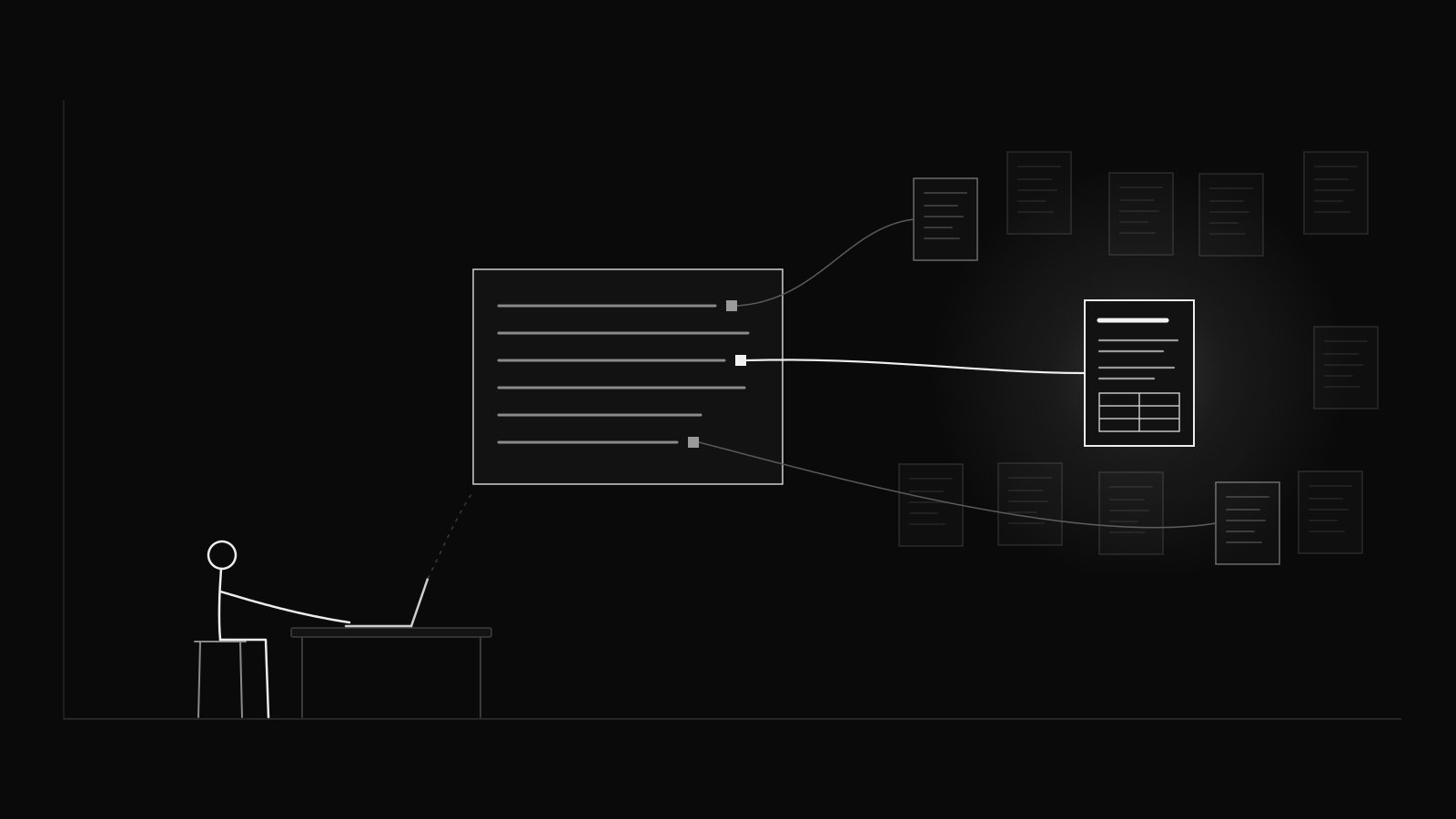


The account looks sensible. The keyword list is logical, the budget is not the problem, and leads arrive regularly. And yet growth feels capped.
Sales teams hesitate. Performance reviews happen. Optimisation follows. Bids are adjusted, ads rewritten, targeting tightened, landing pages tweaked.
What rarely gets questioned is the assumption the entire account is built on.
That assumption is simple. If someone needs what you sell, they will search for it.
For a long time, this belief worked well enough. Today, it increasingly does not.
Why Google Ads feel fine but never decisive
Most Google Ads accounts are built around keywords. Buying decisions are not.
That gap is where performance quietly degrades.
Clicks still happen. Forms still get filled. Costs appear manageable. But downstream, something feels off. Sales conversations start with education rather than intent. Deals take longer to move. Teams argue about lead quality instead of learning from it.
At that point, optimisation becomes the default response.
What goes unchallenged is whether the account reflects how buyers actually arrive at decisions.
The 95/5 reality most teams ignore
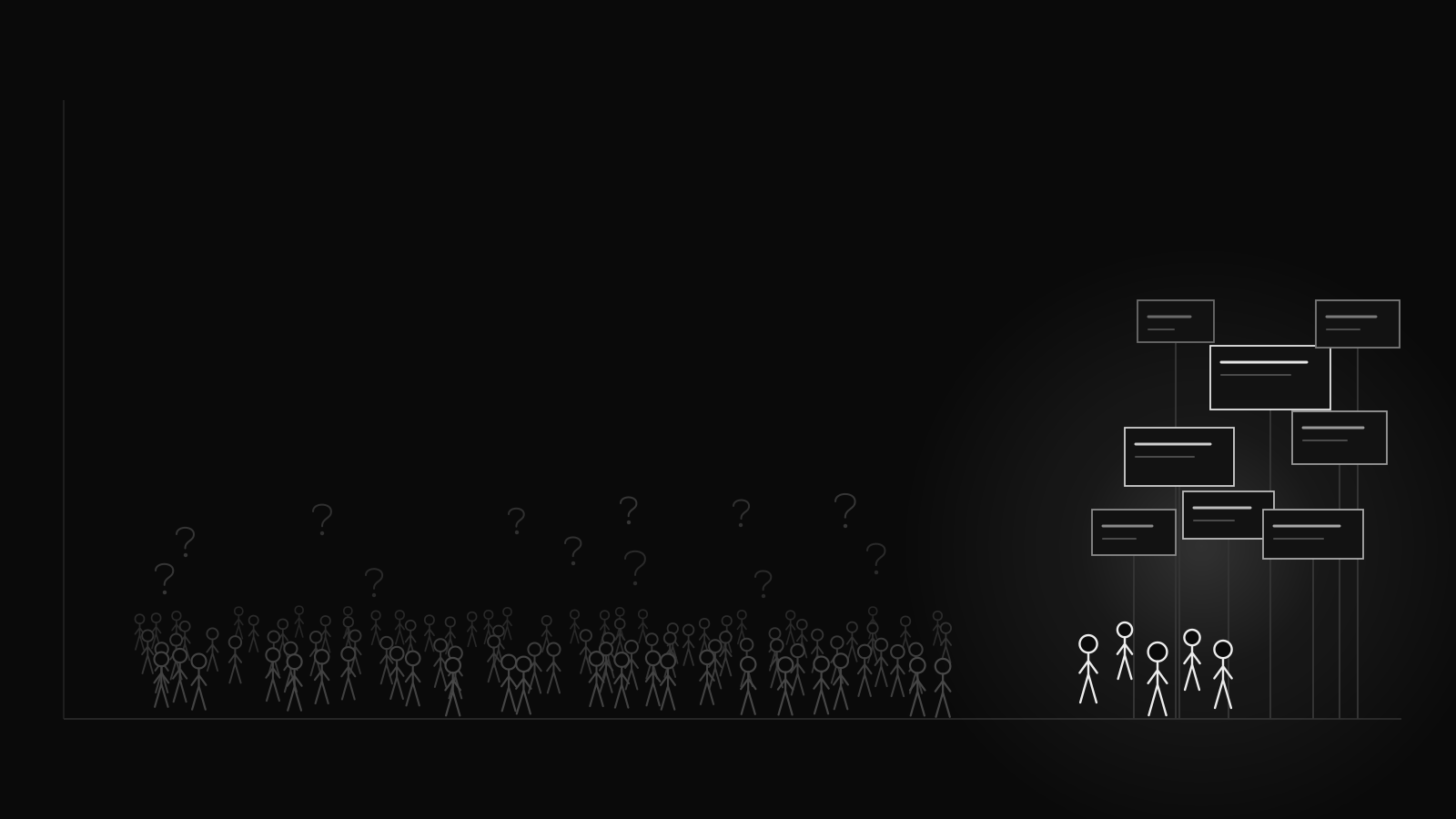
In B2B, only a small fraction of your market is actively buying at any given time.
Research from the LinkedIn B2B Institute consistently shows that roughly ninety-five percent of potential buyers are not in-market right now. Only five percent are ready to evaluate solutions.
Most Google Ads strategies are built entirely around that five percent.
That makes high-intent keywords expensive and unforgiving. You are competing where attention is scarce, expectations are high, and tolerance for confusion is low.
In many B2B SaaS categories, solution-led keywords routinely cost three to five times more than problem-led ones. A fifteen-euro click for “software” versus three to five euros for “how do I fix this?” is not unusual.
When your entire strategy depends on intercepting buyers late, you are paying more to speak to fewer people, at the moment they are least patient.
This is not a bidding problem. It is a sequencing problem.
High-intent keywords are not wrong. They are simply late.
Your B2B market at any given moment
95%
Not in market right now
Problem-aware · Intent-learning opportunity · 3 to 5× cheaper to reach
5%
Evaluating solutions now
Most budgets here
Opportunity: Build campaigns for the 95% before they become the 5%.
Cost reality: Solution-led keywords cost 3 to 5× more than problem-led queries. You compete where patience is lowest.
How buyers actually use search
Buyers do not search to compare options. They search to reduce uncertainty at specific moments.
They do not experience their situation as a product category. They experience it as friction.
Something is inefficient. Something that used to work no longer does. Something feels risky, unclear, or unnecessarily complex. Search is how they try to make sense of that feeling.
The language they use reflects this. It is situational and descriptive rather than categorical. Buyers search for explanations, reassurance, and clarity long before they search for software names or service labels.
Keywords are not intent. They are a symptom of it.
The AI shift most ad accounts are not built for
This behaviour has accelerated as AI has changed how search works.
Buyers now use large language models as filters before they ever open a search engine. They ask ChatGPT or Perplexity something like “Why do my clients keep missing appointments?” and receive a structured explanation of the problem: causes, typical fixes, what usually goes wrong. By the time they reach Google, they already have a mental model of the situation. They’re not exploring. They’re confirming.
This changes the job of a Google Ad fundamentally. An ad that introduces a problem the buyer has already diagnosed is irrelevant. An ad that reflects the conclusion they’ve already reached, and offers a credible next step, is not.
Most accounts are built for the pre-AI version of this journey. Ads introduce the category. Landing pages explain the problem. The sequence assumes the buyer arrives without context.
That assumption is increasingly wrong.
The practical consequence is this: if your ads only appear when someone searches for a tool, you are entering the conversation after the diagnosis has already happened, and after a competitor’s framing may already have shaped how the buyer thinks about the solution. The account structure needs to account for a buyer who arrives more informed and less patient than it was designed for.
A real SaaS example from the field
Here’s what this looks like in practice.
I worked with a SaaS company offering an online appointment scheduling platform for small businesses. The product was strong. Flexible, no-code, and easier to use than many established alternatives.
The challenge was not capability. It was discovery.
Google Ads and SEO were already active. Traffic arrived. Forms were filled. Yet sales conversations kept starting in the same place. Education before intent.
When we analysed search behaviour, the pattern was clear. People were not searching for “appointment scheduling software” because they wanted to compare tools. They were searching because something in their workflow was breaking.
Instead of bidding primarily on category terms, we shifted budget upstream. We targeted situational queries such as “how to reduce no-show appointments” and “clients keep cancelling bookings.”
Those searches converted at roughly forty percent lower cost per qualified lead. More importantly, sales conversations changed. Calls started with a shared problem rather than a product comparison.
The work did not start in the ad account. It started with positioning.
Messaging shifted towards concrete operational friction. The website was redesigned to remove small UX signals that were quietly undermining trust. Search campaigns followed the same logic. Ads reflected the situations buyers recognised. Landing pages explained why scheduling usually breaks before introducing the platform as a possible resolution.
Lead volume did not spike. Lead quality improved. Sales cycles shortened because buyers arrived with context already formed.
This shift did not come from clever bidding. It came from alignment.
Where most founders misread intent
Most teams treat intent as fixed. Either a keyword has it, or it does not.
In reality, intent is progressive.
Buyers move from uncertainty to clarity over multiple searches, not in a straight line. They explore symptoms before solutions. They seek reassurance before comparison.
Founders optimise for coverage. Buyers respond to relevance.
Ads optimise for clicks. Funnels win with continuity.
Google Ads accounts fail when they collapse this progression into a single moment and try to force conversion there.
The two-layer account structure
A Google Ads account that reflects real buyer behaviour has two distinct layers. Each has a different job, and confusing them is where most performance issues begin.
| Feature | Intent-learning (upstream) | Demand-capture (downstream) |
|---|---|---|
| Buyer trigger | “This process is a mess.” | “I need a tool to fix this.” |
| Search goal | Diagnosis | Evaluation |
| Typical query | Situational or problem-led | Category or solution-led |
| Ad promise | Why the problem exists | Why this is the best option |
| Landing page | Educational and safety-focused | Demo, pricing, or trial |
| Primary metric | Search term insight and clarity | Cost per acquisition |
Most accounts are built almost entirely on the second layer, and then blamed when growth stalls.
Ads that mirror, not pitch
Most ads fail because they answer a question the buyer has not asked yet.
In intent-learning campaigns, ads should mirror the problem, not pitch the solution.
That means naming the friction clearly, reflecting the situation the buyer recognises, and avoiding feature-heavy language.
The goal is not persuasion. It is relevance.
When ads feel familiar rather than impressive, engagement improves. Quality Score improves. Sales conversations improve.
Landing pages that create safety
Sending problem-led traffic to demo pages is one of the fastest ways to lose a buyer you’ve already reached.
At the intent-learning stage, the buyer is not ready to evaluate. They’re still forming a view of the problem. A demo page forces a decision they haven’t made yet. The mismatch between where the buyer is and what the page asks of them creates friction that reads as distrust, and most buyers leave without saying why.
Landing pages at this stage have a different job. They should confirm that you understand the problem, explain why it usually exists, and show what typically breaks first. The product appears as a possible resolution, credible and relevant, but not the only point of the page.
Calls to action should match the buyer’s state of mind. ‘See how others solved this’ outperforms ‘Book a demo’ at this stage because it offers progress without commitment. A short case study, a diagnostic tool, or a problem-framing guide all serve this function better than a calendar link.
This does not reduce conversion quality. It improves it, because buyers who move forward do so with context already formed, which shortens the sales conversation that follows.
What to look at instead of CPL
Founders are conditioned to judge everything by cost per lead. That instinct breaks intent-learning work.
These campaigns should be evaluated by signal quality, not efficiency.
Useful indicators include:
- Search terms that clearly describe real situations
- Engagement with problem-led content
- Shorter sales discovery calls because context is already shared
The question is not “Did this lead convert cheaply?” but “Did this search help us understand how buyers frame the problem?”
Where learning feeds back into scale
The biggest mistake teams make is treating intent-learning as an experiment.
Search terms, ad performance, and engagement patterns from these campaigns should inform demand-capture copy, landing page headlines, sales discovery questions, and positioning language.
Over time, high-intent campaigns become clearer, cheaper, and more predictable because they borrow precision from earlier-stage insight.
This is how learning pays for itself.
Closing
Most Google Ads performance problems are not bidding problems. They are sequencing problems.
The account is trying to intercept buyers at a single moment, the moment of explicit search, without accounting for the journey that shaped that search, or the AI-assisted diagnosis that increasingly precedes it.
When the account is restructured around how buyers actually move, from friction to curiosity to evaluation, something changes. Not the budget. Not the platform. The fit between what the ad says and what the buyer is ready to hear.
That fit is what makes a system compound rather than leak.
Keywords are not intent. They are a symptom of it. Build the account around the cause, and the keywords take care of themselves.
If you want a clear picture of where your account and your positioning are misaligned, the Growth Audit is where to start. If the foundation is sound and you need a structured performance plan, see a sample Performance Roadmap output or start a Performance Roadmap engagement.
Common questions
Questions this note answers
Why do Google Ads produce leads but fail to drive B2B growth?
Most Google Ads accounts are built around keywords, but buying decisions are not. The account looks sensible: the keyword list is logical, costs appear manageable, leads arrive regularly. But downstream something feels off. Sales conversations start with education rather than intent. Deals take longer to move. The root cause is a sequencing problem, not a bidding problem. The account is built to intercept buyers at a single moment of explicit search without accounting for the journey that shaped that search or the AI-assisted diagnosis that increasingly precedes it.
What is the 95/5 rule in B2B Google Ads?
Research from the LinkedIn B2B Institute consistently shows that roughly ninety-five percent of potential buyers are not in-market at any given time. Only five percent are ready to evaluate solutions. Most Google Ads strategies are built entirely around that five percent, making high-intent keywords expensive and unforgiving. You are competing where attention is scarce, expectations are high, and tolerance for confusion is low. In many B2B SaaS categories, solution-led keywords cost three to five times more than problem-led ones. The fix is not better bidding: it is building campaigns for the ninety-five percent before they become the five.
What is the two-layer Google Ads account structure?
A Google Ads account that reflects real buyer behaviour has two distinct layers. The intent-learning layer targets upstream, problem-led queries: buyers searching to diagnose friction rather than compare tools. Ads here mirror the problem rather than pitch the solution; landing pages explain why the problem exists rather than pushing a demo. The demand-capture layer targets downstream, solution-led queries from buyers ready to evaluate. The primary metric for the first layer is search term insight and signal quality. The primary metric for the second is cost per acquisition. Most underperforming accounts are built almost entirely on the second layer.
Why do B2B buyers search and how has AI changed that behaviour?
Buyers do not search to compare options. They search to reduce uncertainty at specific moments: when something is inefficient, when something that used to work no longer does, or when a situation feels risky or unclear. The language they use is situational and descriptive rather than categorical. This behaviour has accelerated as AI has changed how search works. Buyers now use large language models as filters before they open a search engine. By the time they reach Google, they already have a mental model of the situation: they are confirming, not exploring. An ad that introduces a problem the buyer has already diagnosed is irrelevant.
What metrics should replace cost per lead for intent-learning Google Ads campaigns?
Intent-learning campaigns should be evaluated by signal quality, not efficiency. Useful indicators include search terms that clearly describe real buyer situations, engagement with problem-led content, and shorter sales discovery calls because context is already shared arriving from these campaigns. The question to ask is not whether a lead converted cheaply but whether the search helped you understand how buyers frame the problem. Over time, the insights from intent-learning campaigns should feed back into demand-capture copy, landing page headlines, and positioning language: that is how the learning pays for itself.
Noticed a typo, technical nuance, or want to suggest an improvement?
Send feedback