


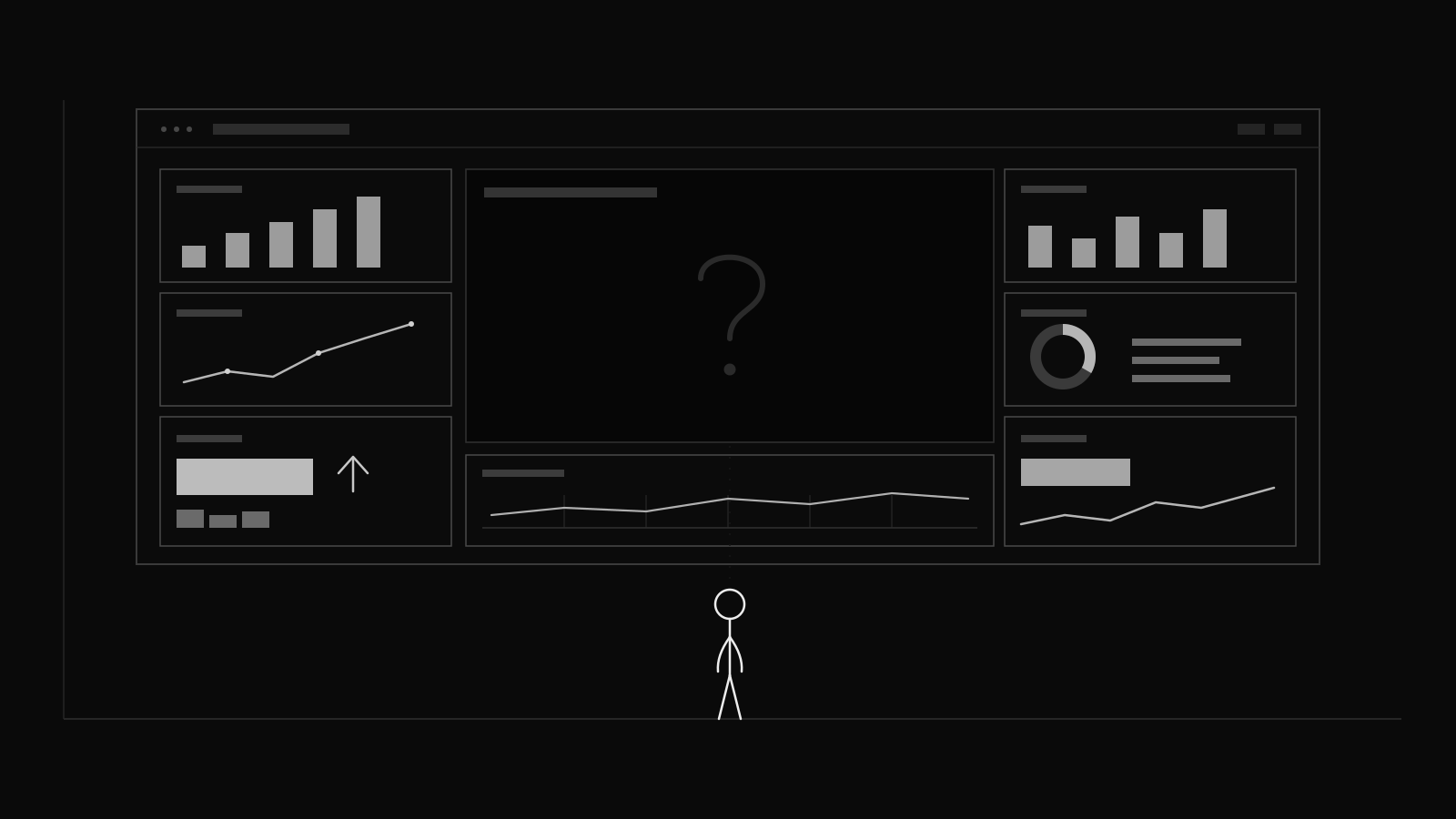
Open your marketing dashboard. It will tell you your cost per click, your click-through rate, how many leads came in last month, and how all of that compares to the month before. Now ask a different question: which of our efforts created the deals we closed this quarter?
Silence.
This is the gap at the centre of most B2B marketing reporting. The dashboard is fluent in activity and mute on revenue. It can describe what the marketing team did in extraordinary detail. It cannot explain what any of it caused.
The result is a reporting ritual most teams will recognise. Numbers go up or down, someone narrates them in the Monday meeting, and the budget decisions that follow are made on instinct dressed up as data. Your reporting shows spending. It does not show what moves deals.
Why B2B breaks attribution software
The standard answer to this problem is attribution software, and in B2B, the standard answer fails for structural reasons, not implementation ones.
Start with how B2B buying actually works. The sales cycle runs months, not minutes. The decision is made by a committee, not a person. And most of the research happens where no tracking script can follow: in LinkedIn feeds scrolled without clicking, in AI assistants that answer the question directly, in Slack communities, in phone calls between peers. By the time someone fills in your form, the decision is often substantially made. The form fill is the end of the story. Your attribution tool records it as the beginning.
Click-based attribution then takes this distortion and compounds it. Last-click models give full credit to the final touch, which, in a six-month committee sale, means the cause of the deal is systematically erased, and the closer of the loop is systematically rewarded. Branded search and direct traffic look like heroes. The webinar that started the conversation four months earlier looks like a cost centre.
Then there is the inflation problem. Every ad platform claims the conversions it touches, using its own attribution window and its own logic. Google claims the deal. LinkedIn claims the same deal. Your CRM counts it once. Sum the platform dashboards, and you will report more pipeline than your company has ever seen. I wrote about a version of this in Your Google Ads account has the wrong model: the platform’s reporting exists to justify its spend. It is a vendor’s receipt, not a measurement system.
None of this means attribution data is useless. It means attribution data is testimony from interested witnesses. You can use it, but you cannot let it preside.
Measurement is a system, not a report
Here is the reframe that matters: reporting is an output. Measurement is infrastructure.
A report is whatever your tools happen to export. A measurement system is something you design: a deliberate set of definitions, capture points, and review rhythms built around the decisions you actually need to make. Most companies have reporting. Very few have measurement.
In The anatomy of a B2B growth system I described measurement as the fourth layer of the system, underneath positioning, demand generation, and conversion. It sits last in the sequence, but it is not the least important, because when measurement is broken, the other three layers become unimprovable. You can still run campaigns. You can still redesign pages. You just cannot learn from any of it, which means every change is a guess and every quarter starts from zero. A team with broken measurement does not compound. It repeats.
This is why “we need better dashboards” is almost always the wrong diagnosis. The dashboard is downstream. The system is what needs building.
The three tiers
A working measurement system separates metrics by the decision they serve. Three tiers, three different jobs, three different audiences.
Tier one: platform metrics. Cost per click, click-through rate, impressions, engagement. These are operational metrics. They exist so the person running campaigns can tune them week to week. They answer the question: Is this channel being operated well?
Tier two: funnel metrics. Lead to meeting rate, meeting to opportunity rate, stage conversion, and velocity between stages. These are diagnostic metrics. They show where handoffs leak, which is usually where revenue quietly dies. They answer the question: where does the system lose people?
Tier three: revenue metrics. Qualified pipeline created, pipeline by source, closed-won revenue, and cost per opportunity. These are decision metrics. They are the only tier that should drive budget allocation. They answer the question: what should we do more of, and what should we stop?
The structure matters less than the discipline it enforces, because the failure mode in most companies is precise and predictable: they make tier-three decisions with tier-one data. Budget moves because the cost per click went up. A channel gets killed because its click-through rate looks weak, while the CRM quietly shows it is sourcing the largest deals of the year. Each tier is honest work at its own level. The damage happens when a metric is promoted above its station.
The minimum viable measurement stack
You do not need new software for any of this. For a team of two to five people, the entire system consists of four practices and the discipline to keep them running.
First, source fields in the CRM, filled at deal creation. Every deal gets an original source and a brief note on how it actually started, captured while the knowledge is fresh. Not edited later, not backfilled at quarter end. This single habit produces more decision-grade data than most attribution tools.
Second, a “how did you hear about us?” field on every form. Free text, not a dropdown. Self-reported attribution is imperfect, but it is the only instrument that sees into the dark funnel. When someone writes “a colleague shared your audit on LinkedIn”, that is a truth no tracking pixel will ever record. Read these answers raw, monthly. They are the most honest data you own.
Third, UTM discipline. A simple naming convention, written down once, applied everywhere, by everyone. Unglamorous, and the difference between source data you can trust and source data you have to caveat in every meeting.
Fourth, a monthly pipeline review with one question per deal: what actually started this? Marketing and sales in the same room, working backwards from real deals to real causes. Thirty minutes. Over two or three quarters, this meeting builds something no dashboard can: a shared, evidence-based picture of what creates revenue in your specific business.
Notice what is not on this list. No attribution platform, no data warehouse, no new tools at all. The constraint is deliberate. Measurement problems in small teams are almost never tooling problems. They are definition and discipline problems, and buying software to fix a discipline problem just adds a subscription fee to the problem.
Direction over completeness
You will not get to perfect attribution. Nobody does, and in B2B, the dark funnel guarantees nobody ever will. That is fine, because perfect attribution was never the goal. The goal is directional confidence: knowing with reasonable certainty which two or three efforts create a qualified pipeline, so the next budget decision is a judgment call based on evidence rather than a guess based on charts.
You don’t need perfect data. Direction matters more than completeness.
If you opened your dashboard right now and could not answer the deal question, that is exactly the kind of structural gap a Growth Audit is built to surface. Share your website, and I’ll send you the three improvements I’d make first.
Common questions
Questions this note answers
Why can’t my marketing dashboard tell me which efforts created revenue?
Most B2B dashboards are fluent in activity and mute on revenue. They report cost per click, click-through rate, lead volume, and month-over-month comparisons in extraordinary detail, but they describe what the marketing team did rather than what any of it caused. The dashboard is an output of whatever your tools happen to export, not a system designed around the decisions you need to make. Connecting effort to closed deals requires deliberate definitions, capture points, and a review rhythm, which is measurement infrastructure rather than a report.
Why does attribution software fail for B2B companies?
It fails for structural reasons, not implementation ones. B2B sales cycles run months, decisions are made by committees, and most research happens where no tracking script can follow: LinkedIn feeds, AI assistants, Slack communities, and peer phone calls. By the time someone fills in a form, the decision is often substantially made, so the tool records the end of the story as the beginning. Last-click models then erase the cause of the deal and reward the final touch, while every ad platform claims the same conversion using its own window. Attribution data is testimony from interested witnesses: usable, but it cannot preside.
What is the difference between reporting and a measurement system?
Reporting is an output: whatever your tools happen to export. A measurement system is infrastructure you design, a deliberate set of definitions, capture points, and review rhythms built around the decisions you actually need to make. Most companies have reporting and very few have measurement. This is why better dashboards are usually the wrong diagnosis. The dashboard is downstream; the system is what needs building. When measurement is broken, campaigns and pages become unimprovable because you cannot learn from any change, so every quarter starts from zero.
How can a small B2B team measure marketing impact without new tools?
For a team of two to five people the system is four practices and the discipline to keep them running. First, source fields in the CRM filled at deal creation, capturing the original source and a brief note while the knowledge is fresh. Second, a free-text 'how did you hear about us?' field on every form, read raw and monthly, which is the only instrument that sees into the dark funnel. Third, UTM discipline: one naming convention, written down and applied everywhere. Fourth, a monthly pipeline review asking one question per deal, with marketing and sales in the same room: what actually started this? No attribution platform or data warehouse required.
Noticed a typo, technical nuance, or want to suggest an improvement?
Send feedback